
AUTOMATED BUSINESS REPORTING
The Report Writes Itself.
You should never be the person who has to log in and hunt to find out what happened, what is stuck, and whether the number on the screen is true.
trusted by: UFC, Caesars Entertainment, Churchill Downs, Neighborly, Supercuts, City of Las Vegas, SDMI, Switch, Silverton, Panda Express, TAO, Ellie Mental Health, Dollar Loan Center, Dot Vegas Domains, HFC, Lithion Battery
















Trusted by UFC, Caesars Entertainment, City of Las Vegas, Supercuts
“Justin's expertise, responsiveness, and genuine investment in our success have been evident throughout this process. We are truly grateful.”
at a glance
An automated business reporting layer: scheduled jobs write a daily snapshot per client, batch routine alerts into one digest, ping a human the moment something needs approval, and run watchdogs that audit revenue truth and catch any reporter that goes silent.
- the problem
- A business running many automated jobs and many client engagements needs to know every day what shipped, what is stuck, what needs a decision, and whether the money on the dashboard is real.
- who has it
- Any operator running multiple clients or many background automations who cannot personally babysit every job and every number.
- the pain
- Status lives in a dozen places, the owner becomes the human poller, real alerts drown in noise, and a wrong number or a dead job can sit unnoticed for days.
- cost of doing nothing
- Missed approvals stall the work, a silent failure runs for days before anyone notices, and a dashboard nobody audits eventually shows a number that is not true.
- what shipped
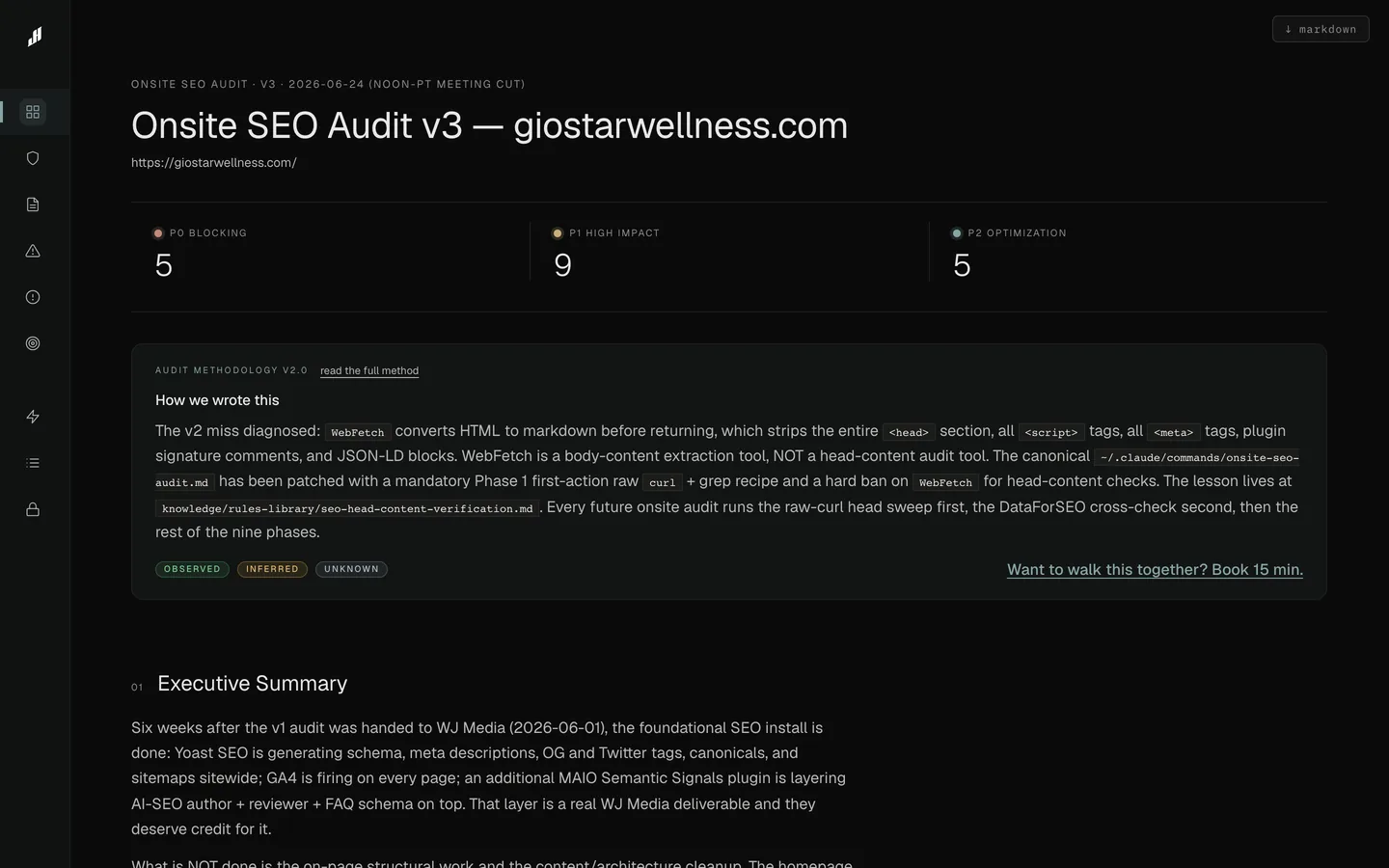
- A published-audit surface where every finding is a tracked issue with a priority, a methodology block that says how the audit was written, and OBSERVED, INFERRED and UNKNOWN tags on the claims so a reader can tell evidence from inference. The client sends their team a link, not a file.
01 · WHY BUSINESS REPORTING NEVER GETS READ
Why Business reporting goes unread.
Status lives in a dozen places. One tool for ads, one for the CRM, one for the site, a channel full of alerts, and a folder of exports nobody opens.
You check things, you ask people, you assemble the picture yourself, and it is stale by the time you have it. Worse, the alerts you set up to protect yourself arrive so constantly that everyone learned to ignore the channel, so the one alert that mattered went by unread.
The part nobody plans for is a job that dies quietly. A report that stops arriving looks exactly like a week where nothing happened.
02 · WHAT AUTOMATED BUSINESS REPORTING MEANS
What automated reporting is.
Automated business reporting is not a dashboard you have to remember to open. It is a set of scheduled jobs that build the report, batch the routine noise, escalate only what needs a decision, and then check their own work.
In the platform I run, that is five jobs working together.
03 · HOW THE DAILY SNAPSHOT IS BUILT
How the daily snapshot is built.
Every day one job runs across every active account and writes a single snapshot for each one. It is composed from the day's recorded events into five sections: what shipped, what is in flight, what is blocked, what was decided, and overall health.
When you open your page, the day is already written.
04 · HOW TO KNOW A REPORTED NUMBER IS TRUE
How the numbers get audited.
Who checks the number itself.
A revenue auditor runs every six hours. It pulls the truth independently from the payment processor and compares it against what the ad platform claims, and it speaks up only when the two diverge past a set threshold or a new untagged charge appears.
Once a week a canary runs a real test charge of one dollar all the way through the pipeline and refunds it, to prove the whole path still works. That job exists for the ads client whose revenue reporting has to be right.
05 · AUTOMATED REPORTING VS A STATUS MEETING
Why not a weekly meeting.
A status meeting is stale by the time it is read and it puts the owner in the middle of every update.
| Option | What it costs | What goes wrong |
|---|---|---|
| A weekly status meeting | Everyone's time, every week | Stale on arrival, and the owner is the bottleneck for anything urgent. |
| Every event to a Slack channel | Constant interruption | Real signals get buried and the team learns to ignore the channel. |
| Trust the dashboard render | Nothing up front | The render is the only line of defense, so a wrong number looks correct. |
| This reporting layer | Part of a service line | It only tells you what it can source, so a gap shows up as a gap instead of as a guess. |
06 · COMMON QUESTIONS ABOUT AUTOMATED REPORTING
Automated reporting questions.
What is automated business reporting?
How is this different from a normal dashboard?
Will automated alerts just bury me in noise?
How do I know the automation itself is still running?
07 · GET A FREE AUDIT
Start with a free audit.
The audit is the same shape as this reporting: a scored, dated, ranked list you can open, not a summary you have to take my word for.
Free, about a day, no call attached unless you want one.
who did the work

I built this because I was tired of clients having to ask me what happened.
I have worked for more than three hundred businesses in this valley.
One name on the account, and it is mine.