
DESIGN SYSTEM
The Brand Lives In One File.
I built the system myself and every surface reads from the same file, so you can check two deliverables side by side and find the same brand on both.
trusted by: UFC, Caesars Entertainment, Churchill Downs, Neighborly, Supercuts, City of Las Vegas, SDMI, Switch, Silverton, Panda Express, TAO, Ellie Mental Health, Dollar Loan Center, Dot Vegas Domains, HFC, Lithion Battery
















Trusted by UFC, Caesars Entertainment, City of Las Vegas, Supercuts
“Justin's expertise, responsiveness, and genuine investment in our success have been evident throughout this process. We are truly grateful.”
at a glance
A whole identity built as tokens so no surface can drift.
- the problem
- A one-operator studio ships brand-carrying work across many surfaces every day, and each of those surfaces is produced in a different session by a different pass.
- who has it
- Operator-led studios and small teams producing a high volume of branded work across web, app, social and document surfaces, who cannot put a designer on every asset.
- the pain
- Without a single source of truth every surface re-decides the brand. Color drifts, type weights wander, corners change, spacing is eyeballed, and the body of work stops looking like one company.
- cost of doing nothing
- The brand reads amateur and inconsistent, a person has to police every asset by hand, and speed dies because every deliverable relitigates decisions that were already settled.
- what shipped
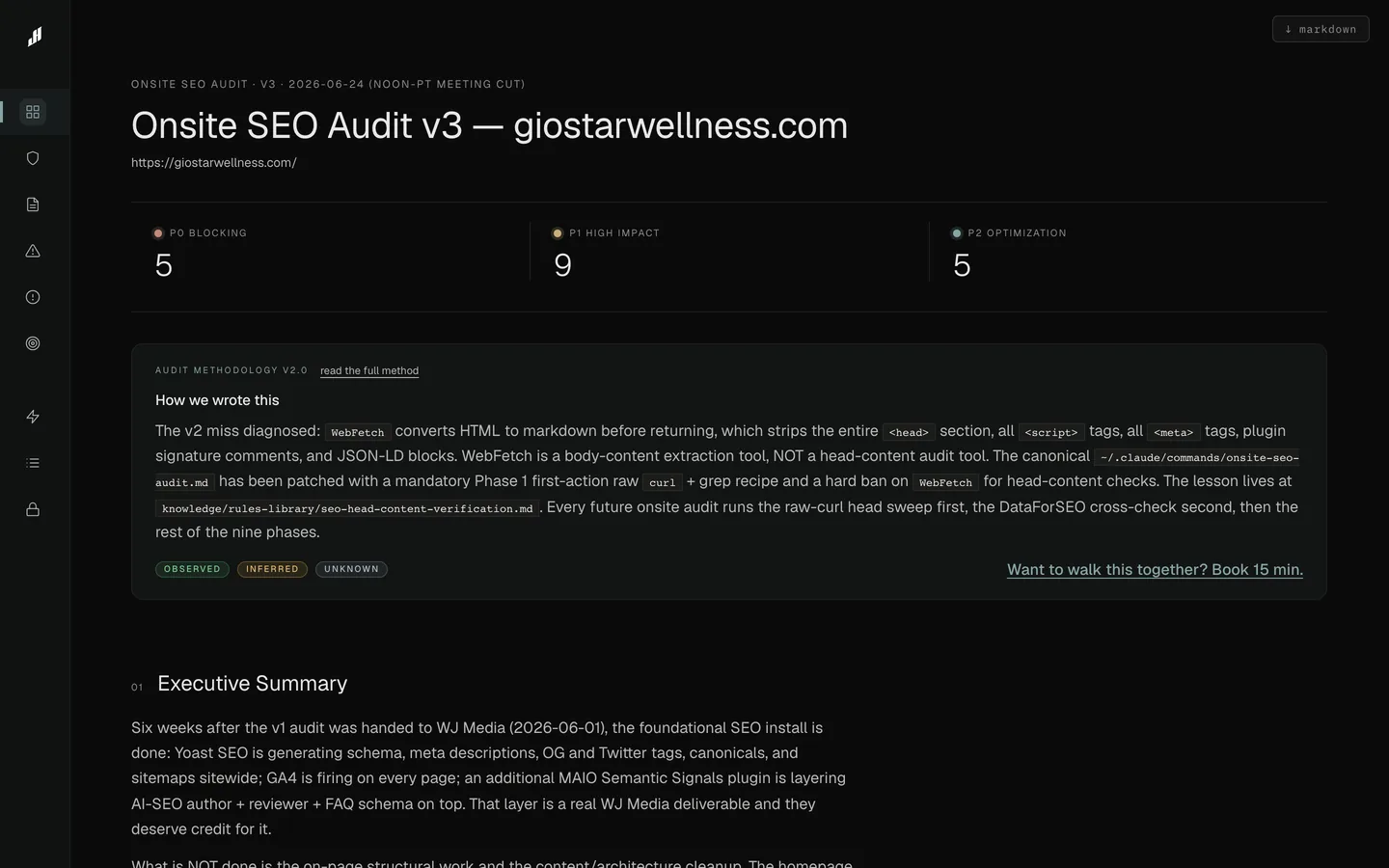
- A published-audit surface where every finding is a tracked issue with a priority, a methodology block that says how the audit was written, and OBSERVED, INFERRED and UNKNOWN tags on the claims so a reader can tell evidence from inference. The client sends their team a link, not a file.
01 · DESIGN SYSTEM VERSUS BRAND BOOK
Why brand books fail.
A design system is the brand expressed as code: one file of tokens deciding every color, type weight, corner radius and unit of spacing, plus components that only read from that file. A brand book is a document that describes the brand and hopes everyone follows along.
The difference shows up at speed. When a website, a client portal, social carousels and branded documents all ship in the same week, a document gets ignored. Color wanders, type weights creep heavier, button corners change shape, and the work stops looking like one company.
So the identity is a system. Consistency is enforced by construction, not by somebody policing every asset.
02 · DESIGN TOKENS
The four layers of the design system.
Tokens are the atoms: a five-level dark surface ramp, a near-white text ramp, one sage accent, a status palette, a locked type pairing, a four-pixel spacing grid, an eight-stop size scale, a radius scale and a motion scale.
Primitives are the components, buttons, cards, panels, status dots, that consume those tokens and never reach for a raw value. Chrome is the assembled surface: the website, the client portal, the carousel template, the document renderer. Patterns are the governed ambient texture.
The whole thing is scoped under one class so it coexists with older work. An on-brand surface takes as long as an off-brand one, because the on-brand path is the only path the components allow.
03 · DARK MODE DESIGN SYSTEM
The dark palette and sage accent.
It is dark first on purpose. Deep navy and charcoal surfaces, near-white high-contrast text, and one muted sage accent.
The mood is a senior operator's command center: calm, capable, in control. The opposite of the glowing-blue-brain look most AI brands reach for, because that reads as a demo and I am not selling a demo.
The accent is used sparingly, for status, calls to action and one section label per surface, never as a loud display color.
04 · HOW TO STOP A DESIGN SYSTEM DRIFTING
What keeps the design system from drifting.
The key decisions are structural locks rather than guidelines.
The radius doctrine fixes one canonical curve across cards, panels, modals, tiles and buttons, and a sharp-cornered button is a defect that halts production. The weight ceiling holds display and body type below a set weight, because heavier reads chunky at hero scale. The pattern layer caps ambient texture at one family per surface, enforced inside the component. Section code cannot use raw values for color, spacing or radius.
None of those are honor-system rules. They are constraints the system imposes, which is the only reason the brand does not quietly drift.
05 · ONE BRAND ACROSS EVERY SURFACE
One brand across every surface.
One identity drives everything. The same tokens style the website, the client portal, the social carousels and the branded documents that go out as proposals, audits and briefs.
Somebody who reads a post, lands on the site, opens the portal and receives a document sees one company, because all four render from the same atoms.
And a brand change is one edit. Change a token and every primitive and every surface updates at once.
06 · WHY A DESIGN SYSTEM MATTERS TO A CLIENT
Why a design system matters to clients.
AI is the engine and this is the floor it stands on. The pass that builds a landing page, the pass that lays out a carousel and the renderer that produces a document all draw from the same tokens, so the output is correct by construction.
That is what lets one marketer produce the volume a small agency staffs for.
The brand is not a file somebody has to remember to open. It is the floor everything stands on.
07 · WHAT A DESIGN SYSTEM COSTS
What a design system costs.
Brand and design is $1,000/month. Same number I quote everybody, printed here instead of held back for a call. Two services together are $1,799 and three are $2,499. No setup fee.
No setup fee, three months, then month to month, and you own the tokens file and every component in it.
08 · COMMON DESIGN SYSTEM QUESTIONS
Design system questions.
What is a design system?
What is the difference between a design system and a brand book?
What surfaces does it drive?
Why dark first with only one accent?
How do you keep it from drifting over time?
09 · GET FREE AUDIT
Get a free audit first.
If two of your own deliverables side by side do not look like the same company, that is a system problem and it is fixable.
I crawl your whole site, score it 0 to 100, and send a ranked list of what is costing you customers. About a day. No call needed.
If the fix is not something I do, I will say so.
who did the work

I build the system so the brand stops drifting the moment I am not in the room.
Fourteen years in the Valley. The work is on a page you can open.
Nobody hands your account to a junior once you have signed.